

The Knicks Are the Perfect Champ For the NBA's Weirdest Era
New York ended 53 years of frustration not with a textbook superteam or an alien-level superstar, but with a roster built perfectly for a league where nobody stays on top for long.

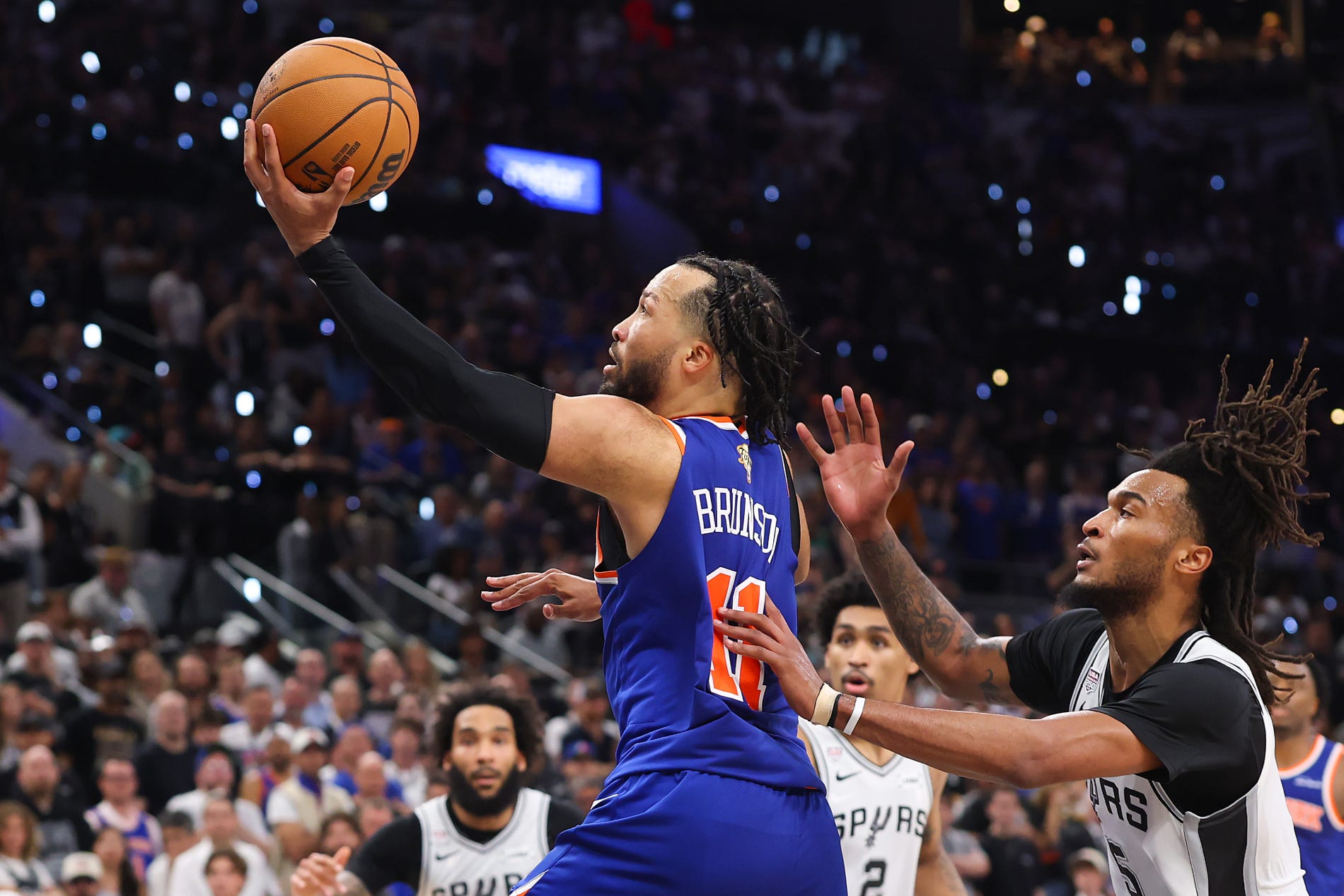
They did it — they actually did it. For the first time in 53 years, the New York Knicks are NBA champions.
It’s a sight that many fans (of the Knicks or otherwise) aren’t quite sure how to process yet. On the one hand, a championship for this franchise probably ought to have happened a long time ago. On the other hand, given how this franchise spent the previous half-century lighting draft picks and cap space on fire, under the direction of one of the worst owners in sports, it feels like an absolute miracle — especially considering this particular team seemingly broke every conventional rule of how modern NBA champions are supposed to be built and come together.
I wrote 14 years ago about the bizarre New York-Los Angeles paradox between the unsuccessful Knicks and the hyper-successful Lakers: In a league often driven by stars choosing where to play, how could the two biggest markets (and arguably most desirable destinations, in theory) be so different? Shouldn’t the gap in all-time titles — 12 for the Lakers since moving to L.A. versus just 2 for the Knicks — be less lopsided?
The explanations I found back then ranged from the Knicks whiffing on the acquisition of Kareem Abdul-Jabbar — the original sin of N.Y. basketball history — as part of the Lakers’ massive advantage on the trade market, to New York’s salary-cap mismanagement, preoccupation with trading draft picks and general habit of betting on the wrong players (with much-loathed owner Jim Dolan sharing plenty of blame for the dysfunction).
It wasn’t like the Knicks still didn’t come close a time or two anyway — they were a Game 7 away from beating the Rockets for the 1994 title, for instance, (Yes, John Starks went 2-for-18 — 0-for-11 on 3-pointers — though none of the Knicks’ best players were especially good in that game.)1 But the Knicks were always the NBA’s most underutilized asset, a flagship brand with little on-court success to show for it.
If you had to pick a year when that trend would reverse itself all at once in a flurry of postseason dominance, however — and the Knicks did finish with the highest PPG differential of any playoff team with double-digit wins, ever (see below) — this would not have been that year… at least, not in a normal NBA era, under normal NBA circumstances.
In fact, if you think about it, the 2025-26 Knicks broke a lot of the rules we’ve come to accept as gospel for how to build a champion.
Supposedly, your best player needs to be an alien like Victor Wembanyama… or LeBron James, Giannis Antetokounmpo and Nikola Jokić. Barring that, he must at least be a savant like Steph Curry (the greatest shooter ever) or Shai Gilgeous-Alexander (the statistical second coming of MJ). Jalen Brunson, by contrast, is famously short and never made first-team All-NBA.
The conventional wisdom also held that a top-heavy team collecting a few huge superstars was preferrable to one with less star power but more quality role-players and depth. The Knicks subscribed to this a bit when they shopped for Karl-Anthony Towns, to be sure, but they also made significant investments in the rest of their starting five — OG Anunoby actually has a bigger contract than Brunson, and Mikal Bridges is pretty close too — and bench support, a number of whom went to college (and won) together at Villanova.
This has left the Knicks looking very different from the typical NBA title-winning blueprint, with far less top-level star power but a lot more depth — something we can see in the numbers, when we compare the regular-season LAKER Wins Above Replacement per 82 team games for their nth-best player (i.e., 1st, 2nd, etc.) with that of other NBA champs, or the typical NBA champ, since 2000:
And so, as much as any team, the Knicks fully represent the NBA’s unprecedented Parity Era — as they sealed the league’s eighth different champion in the past eight seasons:
Maybe that is what it was always going to take to bring the Knicks their long-awaited championship. The NBA’s most strangely underperforming franchise was not rescued by the same superstar-market team-building logic that they tried — and failed — to pursue in the shadow of the Lakers (and others). It didn’t win by making by a freakish, obviously franchise-altering talent the centerpiece of their buildup.
Instead, New York finally broke through with a roster that was less a one-man squad or a superteam than a deep collection of very good players who complemented each other perfectly, and peaked at exactly the right time in a league where nobody else wanted to stay on top for long.
Which is fitting, really: All it took to end the Knicks’ half-century of frustration, and turn them into a champion at last, was just the weirdest era the NBA has ever seen.
Filed under: NBA
Derek Harper was the only Knick who really showed up and played like New York’s season depended on him.