


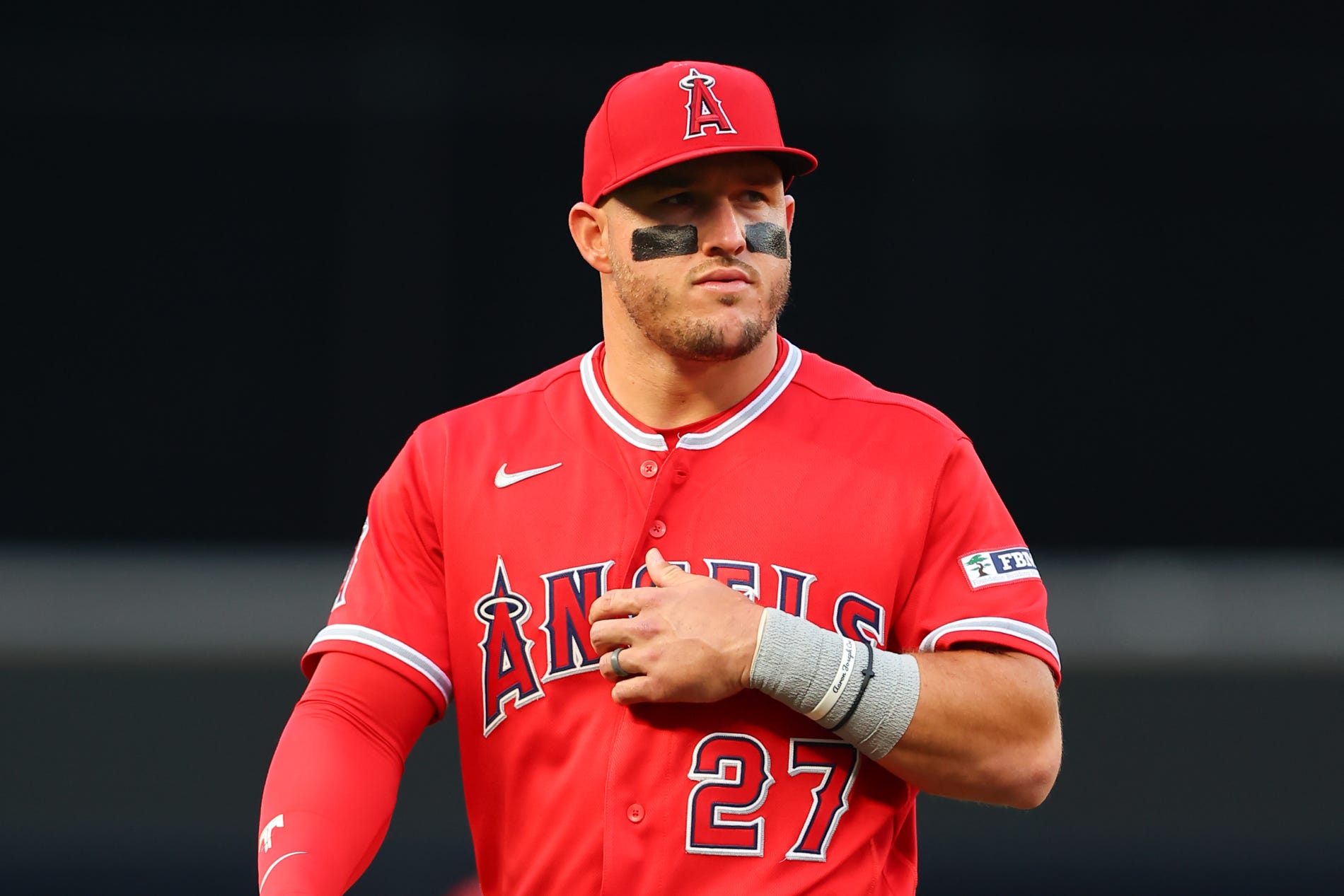
It’s 2026, and Mike Trout will turn 35 later this season. But if you watched Trout play this week’s series against the Yankees in the Bronx, you’d be forgiven for thinking it was the mid-2010s again, and we were all much younger and happier people (Trout included).
Over the course of the Angels’ four-game engagement at Yankee Stadium, Trout had what might legitimately be the greatest series by a visitor in the history of New York’s current building — if not all of its previous iterations as well:


Including those 5 home runs, Trout also had 21 total bases, 9 RBIs, 8 runs scored, 6 hits and a 1.786 OPS in the series. It was truly a tour-de-force performance that recalled some of the other great visiting moments from Yankee history, like this Barry Bonds missile of a HR that I make a point to reference whenever humanly possible:
(Amazingly, Bonds was older there than Trout is now, but Bonds’ late-career performances — however you think he engineered them — were on another planet. We aren’t really expecting to see anything like that anytime soon, unless maybe MLB’s PED policy changes down the line.)
What Trout is currently doing, though, is a version of unprecedented as well. Not even including the fourth Yankee game (as I am writing this Thursday afternoon), Trout was already on pace for 8.6 Wins Above Replacement per 162 team games, which ranked him among the Top 25 or so in baseball across both batters and pitchers, and 18th among batters specifically. For a stat he was once a veritable God of,1 that tally would be the most he’s produced in a single season since he had 9.6 at age 26 in 2018 — a lifetime ago, both in baseball terms and for Trout especially.
As I wrote in 2024, Trout’s inability to lift the Angels out of losing was a metaphor for man’s own futility in the face of our mortality and an indifferent universe. Or something. Then Trout got hurt yet again, which recast him from Sisyphus to something more Promethean — a figure of rare gifts, punished for them again and again. Finally, I concluded last season that the only thing more depressing than an injured Mike Trout was a healthy Trout who proved merely mortal after all.
The Trout we saw in a near-full season (130 games) last year could still hit some — he posted a 120 wRC+ — but otherwise had collapsed to a mediocre 1.7 WAR in overall value, a far cry from his best seasons. Well past his prime and broken down by age and injury, this seemed to be who Trout was now.
But here, in the spring of 2026, Trout has risen again like a Phoenix. (Yes, I am going to keep leaning in the mythological references, and you can’t stop me.) Not only is that 8.6-WAR pace on track to be a return to his earlier-career form, but it would represent possibly the greatest comeback by a once-great player in baseball history.
Here’s a ranking of the best WAR per 162 single-seasons by batters in their 30s who had already established themselves as all-time greats — at least 75 career WAR with a peak season of 8+ — but had gone cold, producing fewer than 20 WAR combined over the previous five years:
Before what Trout is trying to do, only Joe Morgan and Carl Yastrzemski had even broken 4 WAR in a season from this set of starting criteria — and remember, those criteria filter for some of the greatest players of all-time. When FanGraphs and Baseball-Reference update this morning, Trout is likely sitting above a 9-WAR pace!
Even if we include pitchers in the mix, nobody is especially close to Trout; the closest are Bert Blyleven (6.8 WAR at age 34 in 1985), Roger Clemens (5.9 WAR at age 41 in 2004) and Nolan Ryan (5.7 WAR at age 42 in 1989).
Now, am I saying a 34-year-old player coming off an average-at-best season, with an extensive injury history, playing center field again after DH-ing almost exclusively last year, can maintain this pace all year? Sadly, that may be too much to ask for — even of a player like Mike Trout. FanGraphs was projecting Trout for 3.2 WAR this season, as of Thursday afternoon, which itself would be an improvement over any of his past three years. This strikes me as a more probable outcome than Trout turning the clock back to his mid-20s level of performance.
But a player of Trout’s talent was never probable to begin with. And the day we can’t hope for greatness again is the day we shouldn’t even bother showing up. So I choose to believe Trout still has a measure of his old GOAT-level self left to give. Or at the very least, that the Phoenix gets to fly again for a while.
Filed under: Baseball