


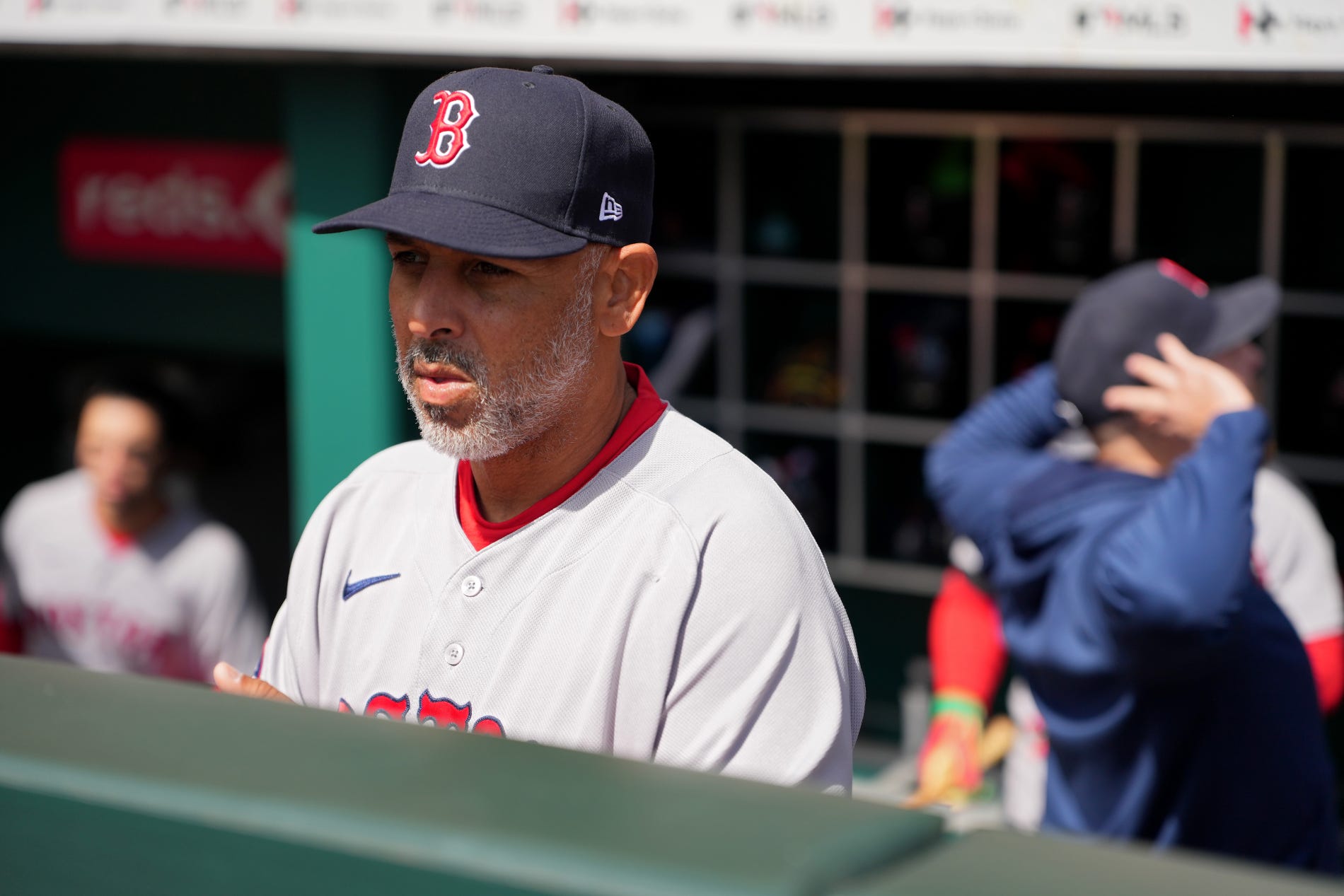
The Boston Red Sox dropped a surprise bombshell on Saturday evening, when they made Alex Cora — who’d managed the club in eight of the past nine years — the first victim of an in-season managerial change this season.
I wrote in the moment that the move felt shocking at first blush: Cora had managed the Red Sox to a World Championship in 2018 and was generally regarded as one of the steadier managerial hands in the sport — notwithstanding that whole Astros cheating scandal he participated in, of course. He was already No. 3 on the franchise’s all-time wins list, at 619, trailing only Joe Cronin (1,071) and Terry Francona (744). If anyone could weather a slow 9-17 start to the season with job intact, it seemed like Cora was the guy.
But Cora had also cashed in just about all the goodwill he was going to from that 2018 run, which is now nearly a decade in the rearview mirror — done with literally no players still on the team’s roster. (The last was Rafael Devers, who was dealt to the Giants in the middle of last season after Boston botched his move from 3B to DH.) The team had a 619-541 record during his time at Boston’s helm, but if you toss out that charmed 2018 campaign — which, while one of history’s best, was also an everything-went-right year that was always going to regress to the mean — Cora’s record with the Sox the rest of the way was only a bit better than .500 overall:
The inability to consistently replicate the highs of the 2018 campaign again for very long — save for a couple of 90-ish win regular seasons and a surprising sprint to a 2-1 lead in the 2021 ALCS (followed by one of the biggest turnabout collapses ever) — cemented Cora’s fate early this season, when a team that was supposed to vie for the AL East cratered to sub-30 percent playoff odds mere weeks into the season.
Then again, Cora was caught up in a long-running Boston baseball trend that is much bigger than any one coach, player or executive, but has extended across nearly two decades of franchise history by now. As I wrote a couple of years ago:
[T]he Red Sox are always the opposite of what you and I think they will be. Are they supposed to be good? There’s a solid chance they’ll be bad, or at least mediocre. Are they supposed to be rebuilding? If history is any guide, that means they’ll probably make a deep postseason run.
Literally, almost no other team in history swings more in its year-over-year performance than the Red Sox have since 2011. You could get whiplash following their ping-pong game between improvement and decline from year to year, practically every single season in that span:
This extends across five general managers,1 six different managerial stints — yes, counting Cora twice — and a who’s-who of stars from David Ortiz and Dustin Pedroia to Mookie Betts and Xander Bogaerts to, most recently, Devers and the current generation of Garrett Whitlock, Jarren Duran, Roman Anthony and Wilyer Abreu.
The Red Sox keep bouncing all over the place because of what Joon Lee calls a “credibility crisis” within the organization:

By Lee’s accounting, the team consistently defies expectations, for good but also for bad — swinging between deep postseason runs and mediocre rebuilding efforts — because of an organizational identity crisis: They’re a franchise that carries big-market expectations, but behaves with the risk-aversion of a small-market team. (To wit: the Sox have somehow not ranked higher than 10th in payroll in any of the past four seasons.)
Between owner John Henry’s retreat from public accountability (despite leading a very public team), a reported culture of “toxic positivity” that acts as though every misstep will simply be ironed out, and the lack of a clear direction in organizational strategy, these behind-the-scenes notes seem to explain why one of the sport’s flagship franchises is so unpredictable, punching below the weight of its own talent, marketing and fan expectations.
In the end, Cora was caught directly in the middle of all this.
When the Red Sox roller-coaster was on its upswing and the team had a 2018 season for the ages, Cora looked like a managing maestro, pushing all of the right buttons en route to a dominant championship run. But that inadvertently set up expectations for the future that were unsustainable, largely by the ownership and front office’s own choice.
Early in his second stint, Cora was the returning hero who spent a year in exile for his crimes, but was back to save the team again. And there were times when that genuinely seemed true. But over the long haul, Cora proved less a solution to the Red Sox’ volatility than a participant in it — subject to the same swings that have defined the franchise for nearly two decades now. And when that instability manifested in this year’s slow start, he was swallowed up by it, too.
Filed under: Baseball
Or “GM-like” figures — essentially, Baseball Ops leaders.
Boston seems like a good candidate to hire the first AI manager in sports, but it won't happen because then they wouldn't have anyone to throw under the bus when it all goes south