


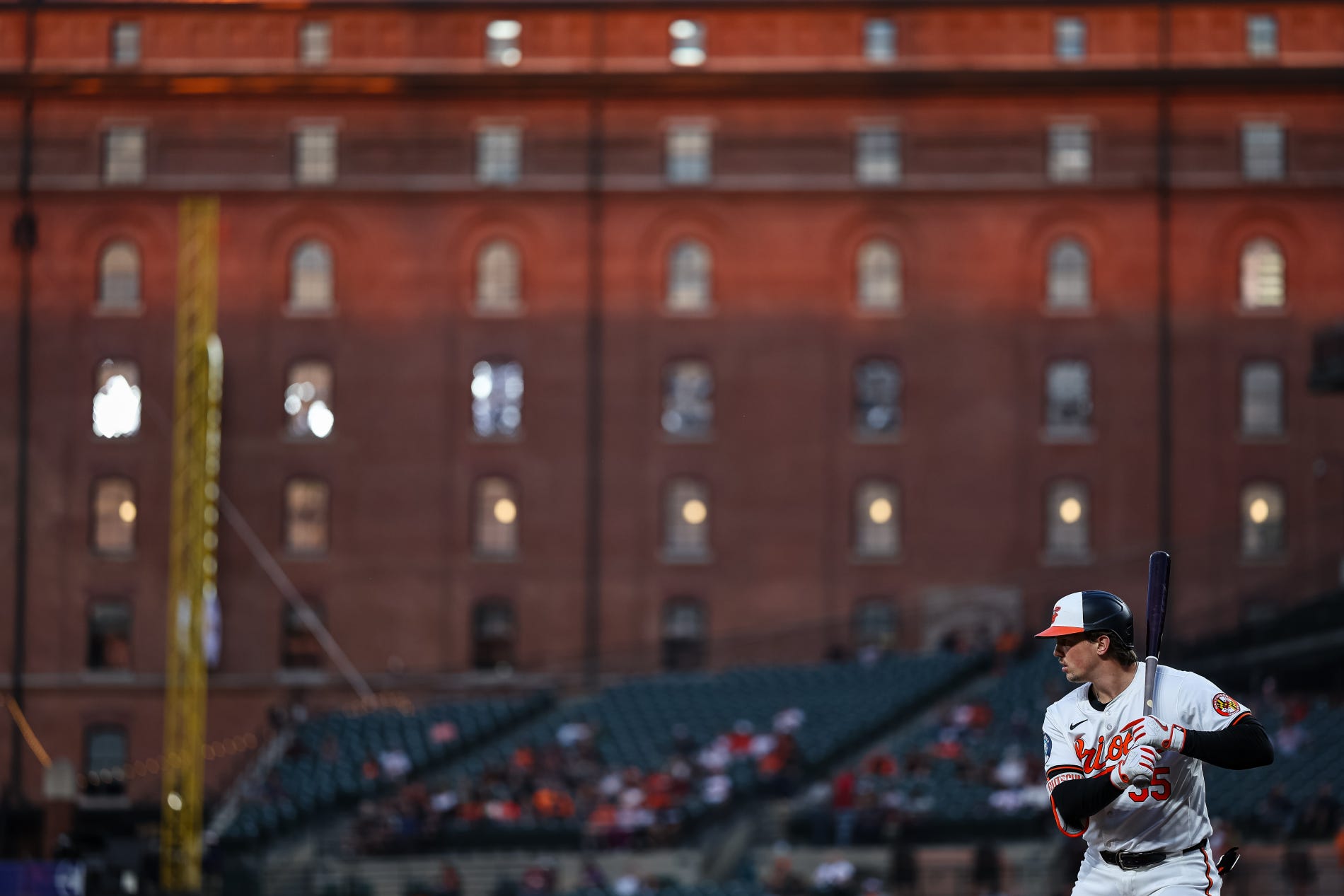
In ESPN’s estimation, the Baltimore Orioles made an A-grade trade with the Boston Red Sox ahead of Monday’s deadline, and it’s hard to disagree.
Desperate for catching, with the league’s fourth-fewest Wins Above Replacement from the position this season, Boston snagged three-time All-Star Adley Rutschman from Baltimore for the steep price of Boston’s No. 1 (Anthony Eyanson), No. 6 (Kyson Witherspoon) and No. 7 (Enddy Azocar) ranked prospects — simultaneously bolstering the Red Sox’s recent surge while helping to restock the Orioles’ prospect coffers, which had dropped to No. 15 in Baseball America’s midseason rankings. Everyone got what they needed.
Except, try telling a Baltimore fan in October 2023 that, in less than three years’ time, the O’s would trade Rutschman to a division rival and you’re all supposed to be happy about it. They’d have never believed you — “and that’s about enough Natty Bohs for you there, hon.”
🦀⚾🧡
The 2020s were supposed to belong to the Orioles. They had the young core to build the next great iteration of a storied franchise that won the most playoff games in baseball from 1966-1983 — including former No. 1 overall pick Rutschman (age 25 in 2023) and 2023 top overall prospect Gunnar Henderson (22), plus Grayson Rodriguez (23), Colton Cowser (23), Kyle Bradish (26), Jordan Westburg (24), Ryan Mountcastle (26), DL Hall (24), Kyle Stowers (25) and Heston Kjerstad (24).
Together, that group helped Baltimore boast MLB’s fourth-youngest roster and fourth-best farm system in 2022, and the 10th-youngest roster with the No. 1 farm system in 2023. More talent was on the way soon, too — with another No. 1 overall pick, Jackson Holliday, set to debut in 2024, and big sluggers Samuel Basallo and Coby Mayo not far behind.
All of that was building up in the pipeline even as Baltimore was also improving rapidly at the major-league level as well. The O’s went from a ghastly 52-110 record in 2021 to 83-79 in 2022, only running out of gas late in an unexpected push for a Wild Card spot, and then rose to an incredible 101-61 in 2023 — becoming the youngest team to win 100+ games since the 2001 Oakland A’s (and second-youngest since the 1988 Mets), while also being just the third-ever squad to post 100+ wins after ranking as Baseball America’s top organization in preseason.1
Even after losing the ALDS to Texas in a surprising sweep, the future was nothing if not bright. I wrote immediately afterward that Baltimore had a World Series future written all over them, despite the early playoff ouster:
The Baltimore Orioles Are Built to Win the World Series — Just Not This Season

Baseball’s postseason can stomp out a team’s hopes in a hurry. Just ask the Baltimore Orioles. After winning an American League-best 101 times during the regular season, Baltimore’s playoff run ended just three games later, as they were unceremoniously
After all, historical teams who carried Baltimore’s combination of youth, prospect pedigree and early success rarely failed to at least make some kind of extended run over the years that followed. As I noted back then, there were 20 or so historical teams2 who had met the following criteria since 1984:
Top-10 in WAR from position players
Top-10 in WAR from pitchers
Top-10 in youngest average roster age
Top-5 in Baseball America’s farm-system rankings going into the season
Those teams averaged 98.4 wins per 162 games during the season in question, a shade below Baltimore’s own total of 101. They went on to win 94.2, 96.3 and 90.8 games over the following three seasons, or a total of 281.3, with a handful of them winning at least 1 World Series title.
🦀⚾🧡
The Orioles, on the other hand, followed a solid 91-win campaign in 2024 with a catastrophic start in 2025 (en route to just 75 wins), and now are on pace for 78.1 wins in 2026 — a figure that is sure to get worse from here.
Add it up, and Baltimore’s projected three-year win total of 244.1 is tracking to miss the group average by nearly 40 total wins. Among our group of comparable teams, only the post-1994 Expos (240.2 wins)3 had a more disappointing next-three-years after such a promising start — and their extenuating circumstances involved a strike that canceled the World Series and made them one of baseball’s all-time “what if?” stories:
Would The Expos Have Won The 1994 World Series?

As soon as New York Yankees reliever Bob Wickman heard the ball leave Larry Walker’s bat, he knew it was trouble. Walker, the Montreal Expos’ 27-year-old right fielder, had been hitting well enough in the World Series before the bottom of the 11th inning in Game 7. But he’d also been held homerless until coming up in this crucial spot, with two runners on base in the bottom of the 11th inning of Game 7. As the championship hung in the balance, one swing changed everything. A year after Joe Carter won the 1993 World Series for another Canadian team
The Orioles have no such monumental excuse for fumbling away what should have been a golden generation in Birdland black and orange.
🦀⚾🧡
Much like the Cubs and Astros (and sort of the Phillies) before them, the original premise of GM Mike Elias’ Baltimore rebuild was to bottom out horribly, then create a sustainable window of contention built around a continuous pipeline of cheap, homegrown talent. The 2023 Orioles got 34.4 WAR from players who debuted with the franchise — which ranked second only to the Houston Astros (at 39.6) that year, and is still the 30th-most by any MLB team since the ‘94 strike.
The idea isn’t a bad one. (The Dodgers have used a continuous, machine-like pipeline to power their rise to the game’s most dominant juggernaut.) But that approach only works if the homegrown talent keeps blossoming, the system keeps churning out prospects, increases in spending are used to make good bets — I’ve found before that this stage of the rebuild-cycle is actually the most important — and playing time isn’t wasted on bad players.
The O’s met their recent downfall because essentially none of those components slid into place: Their homegrown players (like Henderson, Cowser, Mountcastle, etc.) fell from collectively producing more than 31 WAR per 162 in 2023-24 to around 15 each of the past two years; their prospect pipeline was in need of refreshing after Holliday’s cohort broke in; their external acquisitions have been hit-or-miss — a Tyler O’Neill for every Pete Alonso — even as their payroll rose from 25th to 12th; and they gave negative-WAR players enough rope to cost the team a staggering 11 wins in 2025 (though this problem has mercifully improved in 2026).
In fairness to Elias and the Orioles, Baltimore isn’t alone in trying to pivot after a young core failed to launch as expected.
The Kansas City Royals seemed like they might vie with Baltimore for the American League’s Next Big Thing, parlaying their own highly-rated prospect class (with generational SS Bobby Witt Jr. leading the way) into 86 wins and a playoff berth in 2024… but they’ve fallen off as bad or worse than the O’s have. They’ll be lucky to win 70 games this year.
Meanwhile, the Toronto Blue Jays are constantly teasing fans with their talented young cores, only to have them fall short of expectations. (And then bounce back again… and then disappoint again.) Building a winning baseball team is hard; no group’s success is guaranteed, no matter how bright their future appears.
🦀⚾🧡
Fast-forward to Monday, and Baltimore closed the book on at least part of the once-promising 2023 O’s era when they shipped Rutschman to Boston. Though the Orioles were among the many, many teams hanging around the periphery of the playoff race on Deadline Day, the Red Sox simply made them an offer they couldn’t refuse for their erstwhile cornerstone catcher. And so, when we look at net WAR talent added minus subtracted, the Orioles ended up being the fourth-biggest net seller in baseball during the lead-up to the deadline, behind only the New York Mets, San Francisco Giants and Detroit Tigers.
Again, this was the prudent thing for Elias to do as steward of the franchise. The best moves for 2026 and beyond can’t be beholden to a ghost of the 2023 team that never actually came into existence. The responsibility is to maximize the future, not dwell in a lost version of the past.
But the symbolic meaning of trading Rutschman — to the Red Sox, of all teams! — is also unavoidable. He was the No. 1 pick who embodied the reward for all those losing seasons at Camden Yards, the player whose arrival announced that the future had finally become the present again in Baltimore. Now, before that future could even produce a single playoff victory, the Orioles have converted him back into prospects and begun the cycle all over again.
Mainly, it’s a reminder to enjoy every season for what it is, on its own terms — because even the best young cores, with seemingly unlimited future potential, can fumble away their moment before anyone realizes it’s gone.
Filed under: Baseball
The others were the 1999 Atlanta Braves and 2021 Tampa Bay Rays.
The original story had 21, but the sample currently has 20. The discrepancy is due to subsequent recalculations in the WAR formula.
Remember, shortened seasons were prorated to 162 games.
Since moving to Baltimore, I've experienced extreme whiplash with this Orioles team. When we got here, we'd use games (with $3 tickets and $8 beers) as a place to meet and catch up with friends. Then, one game in 2022, they hit 3 home runs in a single inning and we realized that the team might actually be good!
The 101 win season in 2023 had incredible vibes throughout the city! By that point, I could only name one player on my former team (the Red Sox), we all got O's shirts and nodded to everyone we saw wearing shirts around town or at the supermarket. The disappointment of the playoffs felt like a rite of passage; a young team taking its licks at the beginning of something better.
By last year, the vibes were mostly dead, though I tried to convince anyone who would listen that they were on a division-leading pace since Gunnar Henderson returned from his April injury. In retrospect, nearly all of Elias's trade deadline purges paid off. None of the players who seemingly had career years last year have played well (or even that much) this year.
Despite being "in the mix", this season has felt terrible. Not only are we losing most of our games, but ticket and concession prices are still at hopeful levels. Gunnar has had a down season. Many were surprised when Adley was named to the ASG. Basallo is already putting up better numbers at the plate. All we can do is hope that the new new generation develops quickly, but I can't imagine recapturing that 2023 feeling without an undercurrent of dread from the past few seasons.
The Orioles are 1.5 games out of a playoff spot, and once the playoffs begin, we are largely dealing with coin flips. I do not understand why they are punting on this season, and potentially the future, when they still have a 15% to 20% chance of making the expanded playoffs and, once there, roughly a 12% chance of winning the pennant.
This just makes me so angry at MLB. What is the point of expanding the playoffs if teams that are actually close to qualifying start giving up?
You see something similar in the NBA, where teams seeded seventh through tenth rarely have a realistic chance. But you do not see it in the NHL, where there is an understanding that once you are in, anything can happen. The playoff gate also represents meaningful revenue.
MLB has devalued the regular season in order to make the playoffs more valuable. But the behavior of teams like the Orioles suggests that the teams themselves do not actually value the playoffs.