


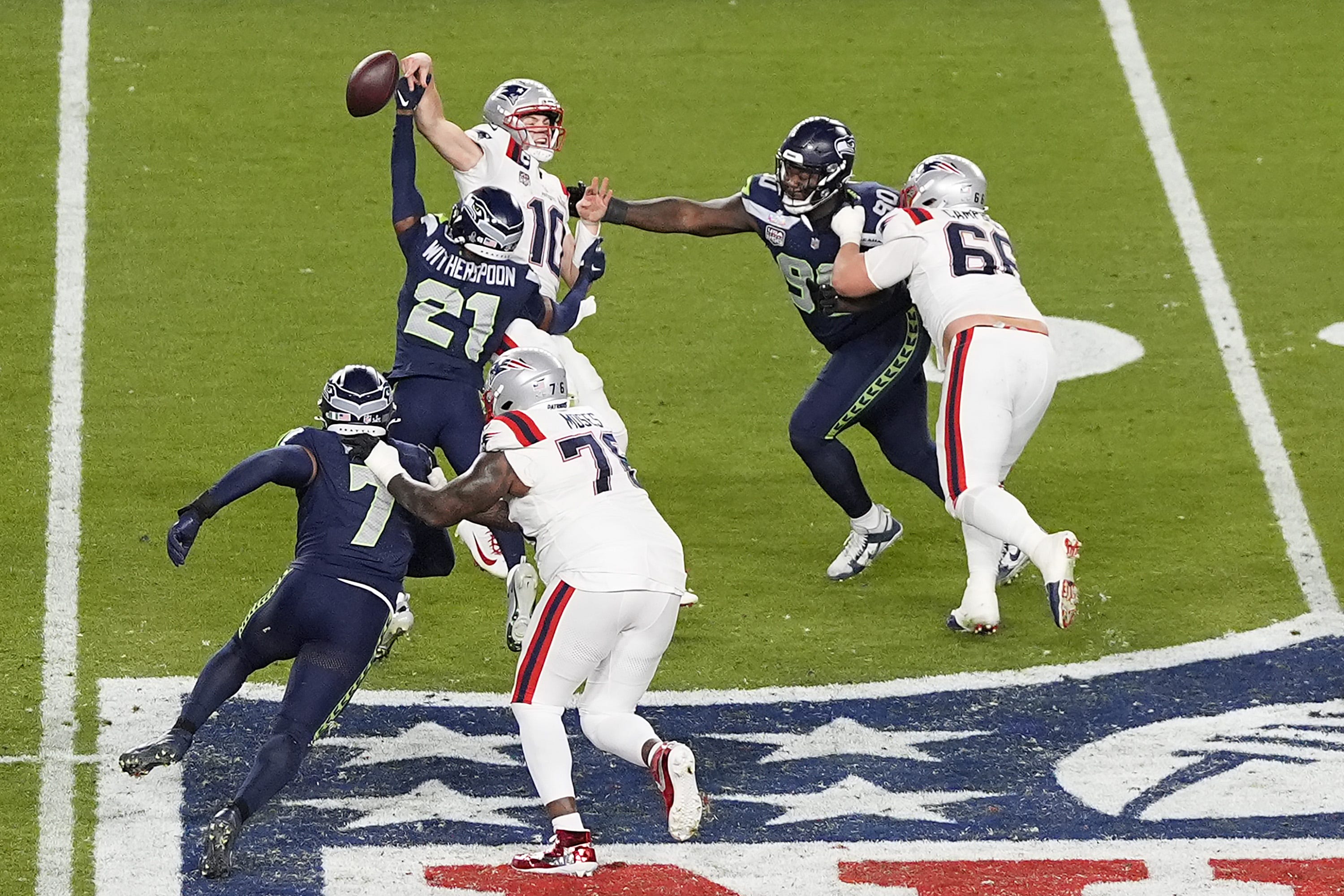
When Drake Maye first went to a Super Bowl in the Bay Area, the Huntersville, NC native was a 13-year-old Carolina Panthers fan watching his favorite team play in the big game — and his team was on the receiving end of a defensive clinic by MVP Von Miller and the Denver Broncos. In his first Super Bowl as a player on Sunday night, he felt the effects of another historic defensive showing on the big-game stage — this time courtesy of the 2025-26 NFL champion Seattle Seahawks, whose performance against Maye and the Patriots solidified their place in history as well.
The topline numbers for Maye’s offense superficially look non-horrible: New England produced 300 yards of offense and Maye had more yards (295) and a higher passer rating (79.1) in losing than his counterpart on the other side, Sam Darnold. But most of that was compiled in garbage time, once the game was practically lost already. For the majority of the game, the Patriots’ offense had zero answers for the Seahawks’ “Dark Side” defense, which forced three turnovers — including a pick-six late in the fourth quarter — and sacked Maye six times.
It was a stunning display against a quarterback, in Maye, who had been the most outstanding statistical passer in the league during the regular season — an accomplishment driven in large measure by his historic accuracy in Completion Percentage Over Expected. Confused and shaken by Seattle’s pressure defense, cooked up by Seahawks coach Mike Macdonald and defensive coordinator Aden Durde, little of Maye’s pinpoint passing was apparent on Sunday night.
Some might chalk up the Patriots’ dismal offensive showing to them being exposed as frauds on the biggest stage in the sport, after playing one of the weakest schedules of any team in Super Bowl history. But as I found going into the game, schedule strength can only explain so much about a team’s play in the Super Bowl. (Indeed, two of the three teams who’d played weaker schedules than New England actually won their Super Bowls.)
Instead, the Seahawks deserve credit for dominating a team that had been as good as New England, who was legitimately one of the league’s better teams even after adjusting for their opponents faced. If we use Pro-Football-Reference’s Simple Rating System (SRS) to compare the number of points a team actually allowed in the Super Bowl to how many we’d have expected an average team that year to allow, the Seahawks’ final figure on Sunday ranks 16th-best in a Super Bowl since the 1970 merger:
That number would have been Top-6 on the list until the Pats scored a garbage-time TD with 2:21 left in the game, a more representative statistic for their performance — and one which would not have ranked too far behind what the team’s previous championship defense, the “Legion of Boom” did to Peyton Manning and the Denver Broncos in 2013-14.
Among the most stellar defenders for Seattle on Sunday night were Devon Witherspoon, Derick Hall, Byron Murphy II, Julian Love and, of course, Uchenna Nwosu, whose 44-yard pick-six effectively ended any hope of a New England rally with under 5 minutes left in the fourth quarter.

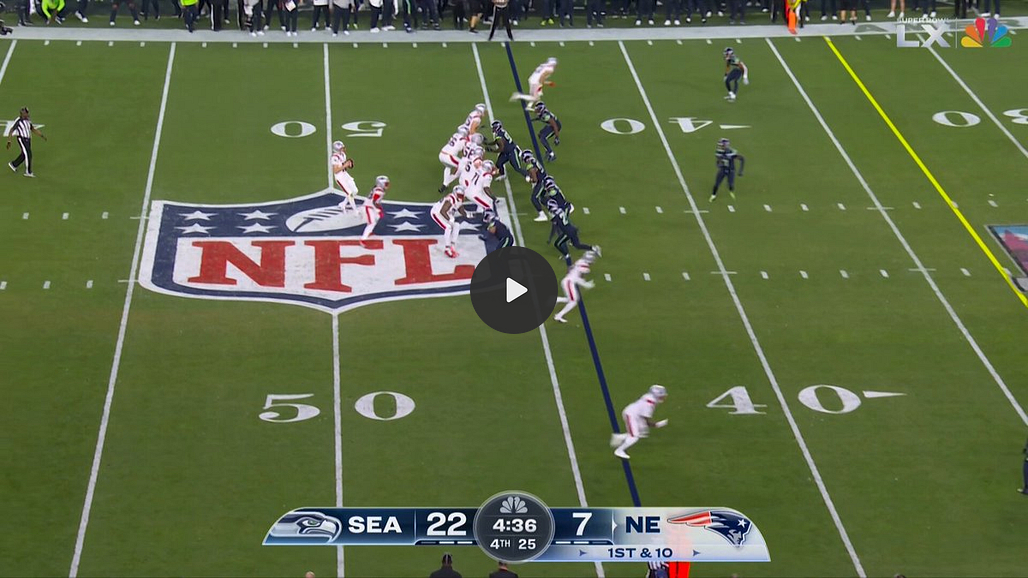
The Seattle offense wasn’t as impressive as its defense. Again, Darnold ended up with superficially worse basic numbers than Maye, though his performance was less damaging (if hardly sharp in its own right). Kicker Jason Myers, with five field goals and a position-record 17 points, made a serious MVP bid.1 But Kenneth Walker III’s 135 rushing yards — 161 from scrimmage — helped him run his way to MVP honors, becoming the first RB to claim the award since Terrell Davis for the Broncos at the end of the 1997-98 season:
The overall effect was that of a team winning its way — with a dominating defense and the offense it needed. Super Bowl LX wasn’t always the prettiest, but it did result in the best team in the NFL claiming the championship with a defensive masterclass that stands alongside the Legion of Boom’s best, or the one Maye witnessed as a young fan — then found himself subject to a decade later, in the same building.
Filed under: NFL
Which says something about the general state of Seattle’s offense.