


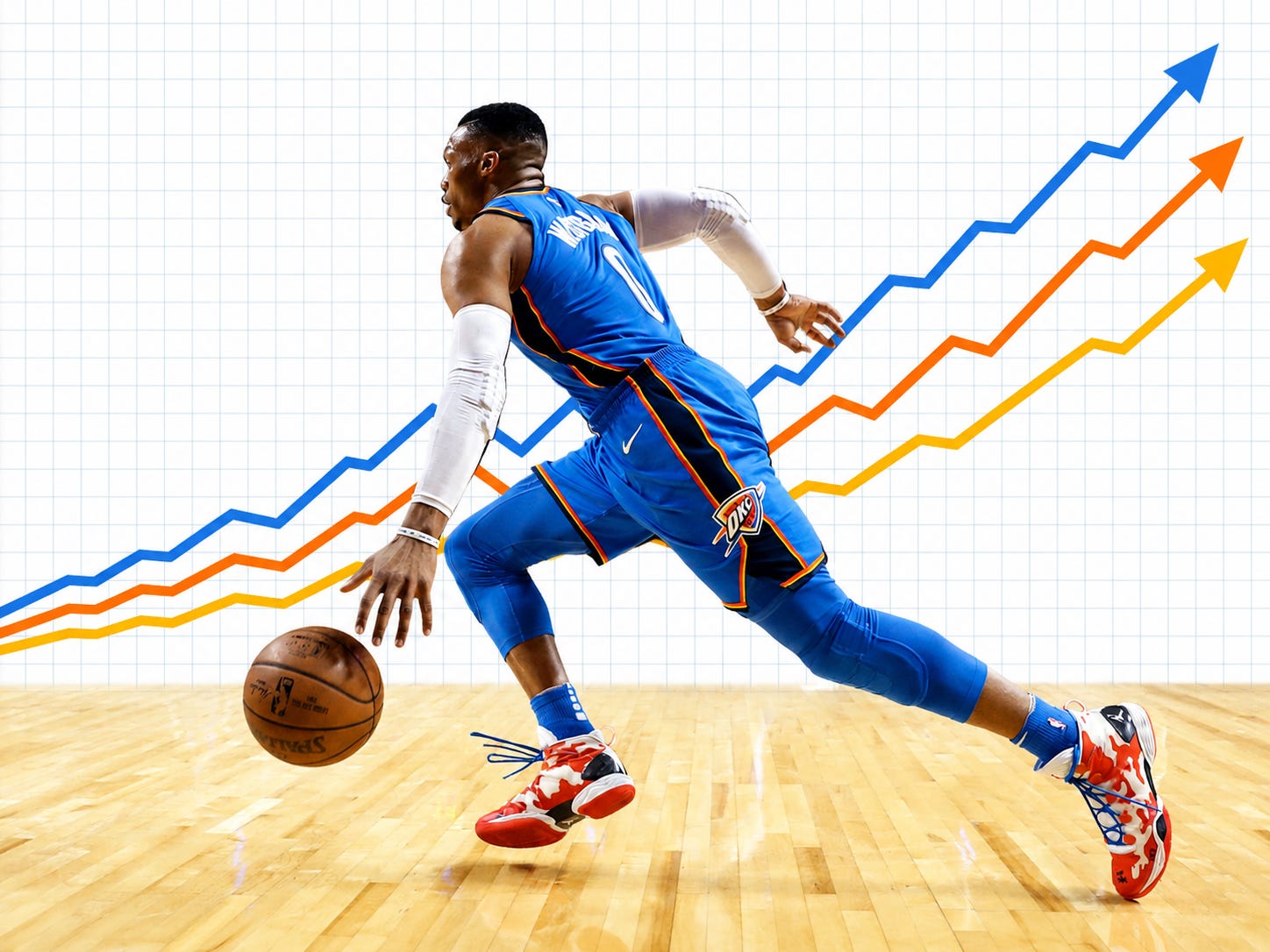
Russell Westbrook’s retirement last week was an occasion to be nostalgic for the peak of one of basketball’s most electrifying players — a relentless 6-foot-4 wrecking ball of pure kinetic energy, who played every possession as if the opposing team had personally insulted him.
But for me, it was also an occasion to revisit Westbrook’s complicated relationship with the statistical record book. It was through numbers that we came to define his greatness, even as Westbrook spent his career changing what they meant — and exposing their limitations.
One of Westbrook’s lasting legacies as an NBA player will come down to two words:
Triple. Double.
Nobody was better at breaking double-digits in the point, rebound and assist columns1 than Russ, who retires as the NBA’s all-time leader in single-season and career triple-doubles after having long since surpassed Oscar Robertson in both categories:
Before Westbrook came along, nobody had come within 43 of Robertson’s career mark since Magic Johnson’s final triple-double on February 14, 1996 — or within 10 triple-doubles of Robertson’s single-season record since Wilt Chamberlain in 1968. But Russ tied the career mark of Jason Kidd (at the time, the most recent prolific triple-double merchant) in 2017 and just kept going — passing Chamberlain,2 Magic Johnson and, finally, Oscar in 2021 to become the all-time career leader in the stat.
Along the way, Westbrook not only broke Robertson’s single-season mark of 41 triple-doubles from 1962, but he also became the first player since Oscar that year to average a triple-double per game: 31.6 PPG, 10.7 RPG, 10.4 APG.
It was something I’d long considered impossible in modern basketball, as the conditions of the league in the 2000s bore little resemblance to the high-pace, high-shot-attempt and high-rebound environment of 1962, which I believed was required to challenge numbers like Oscar’s triple-double average or Wilt’s 50.4 PPG season that same year:
Stray Thoughts on 1962

Last weekend, I watched the greatest PG of all time sit down for an interview with LeBron James, and Magic eventually got around to asking LBJ whether he thought he could average a triple-double for an entire season, the way Oscar Robertson did in his mythical 1961-62 campaign (30.8 PPG, 12.5 RPG, 11.4 APG). The King responded by saying…
So taken was I with Westbrook’s accomplishment that I called it the “best individual season anyone has ever had in NBA history” on Hot Takedown and advocated for him to win MVP on the basis of the historic combination of numbers he produced:
“The fact that a record that seemed like it was one of the most unbreakable records in sports history fell, I think, means something. And I think it would be a crime to not recognize that particular performance with the MVP award.”
But to adapt a line from Dr. Ian Malcolm, I was so preoccupied with what Westbrook had done that I didn’t stop to think about how he’d done it. On a post-Kevin Durant Thunder team that completely revolved around him — and his statistical accumulation — Westbrook had the perfect set of conditions to break Robertson’s 1962 records. In the process, though, he also broke the meaning of what he’d done.
As Seth Partnow later wrote in his book “The Midrange Theory”, Westbrook’s quest for triple-doubles became a textbook example of what’s called Goodhart’s Law: “When a measure becomes a target, it ceases to be a good measure.”
The triple-double had traditionally been valued because it meant a player had organically dominated every facet of a game. Statistical versatility, after all, typically amplifies a player’s overall value above and beyond the base value of each action. But once Westbrook and the Thunder began explicitly optimizing for triple-doubles — by not only running an astronomical share of possessions through him,3 but also by having teammates deliberately box out to leave Westbrook uncontested defensive rebounds — the achievement no longer necessarily meant what we had assumed it did.
Westbrook remained a highly valuable player, to be clear. But many of those rebounds added to his total without adding a rebound to Oklahoma City’s as a team — somebody would have grabbed it one way or another. And that reflected the larger problem with Westbrook’s triple-double pursuits: His individual numbers were becoming untethered from their marginal effect on his team’s bottom line, then were cited as evidence of an impact greater than they actually had on the court.
Much like when a dominant F1 driver or altitude-aided baseball slugger does too well, there’s also an uncanny valley in the stats where we stop being in awe of historic numbers and start to wonder whether they truly reflect greatness. Westbrook hit that point when the full-season triple-double average went from not happening for 55 years… to happening again the very next year (he averaged 25.4/10.1/10.3 in 2017-18). And then again the year after that (22.9/11.1/10.7). And then again (!) two years after that (22.2/11.5/11.7), this time on a 34-38 Washington Wizards team.
What was once a historically singular achievement became so devalued that Westbrook barely received any MVP votes at all for doing it a fourth time — just four years after doing it the first time had been the main factor to win him the award.
The downstream effect of this was to also change the other boxscore-influenced stats we use to judge players. Daniel Myers, inventor of Box Plus/Minus (BPM) — one of the best, most popular and longest-running per-possession value estimates — eventually overhauled the metric partly because its nonlinear interaction terms among usage, rebounds and assists couldn’t properly handle an outlier like Westbrook. As a result, Westbrook’s 2016-17 campaign dropped from the greatest modern NBA season to simply one of many all-time seasons (of which more are being added all the time, as more stat-stuffers have followed in Westbrook’s footsteps).
But while the argument should be made that Westbrook changed the triple-double forever, it might not all be for the worse. Before he came along, they were largely an argument-ender — proof of greatness unto themselves. Now, they simply start a conversation about how the numbers are produced and how much team-level value they actually represent. I, for one, won’t be making an MVP argument solely on the basis of averaging a triple-double over an entire season again, and I suspect I’m not alone there.
In that sense, Westbrook did not make triple-doubles meaningless; he just made them insufficient to capture the total impact they always purported to represent. And that’s pretty fitting for Westbrook himself as a player, too: No statistical shorthand could have fully captured the combination of stamina, explosiveness, durability and sheer will that made him one of the defining NBA stars of his era. Westbrook spent a career filling the box score until it overflowed — and in doing so, forced us to rethink what each number actually meant.
Filed under: NBA
He never achieved a triple-double without at least 10 points, rebounds or assists (which can be done occasionally).
Wilt is listed at 78 in the official Basketball-Reference leaderboard, but he has 109 unofficially if you add up the site’s game-by-game accounting.
Westbrook’s 2016-17 featured the highest single-season Usage Rate (41.65%) in NBA history, plus the third-highest single-season Assist Rate (57.30%) as well.
Westbrook was one of the worst volume shooters in NBA history, whether measured by TS%, EFG%, or 3PT%. Conversely, he took shots away from one of the greatest, most efficient scorers we have ever seen, Kevin Durant. He was uncoachable, especially in his later years. Ty Lue could not play him in the 4th quarter of games despite LAL's need for a PG because of his poor decision-making. An athletic marvel to be sure, but it is almost laughable he will be inducted into the Hall of Fame except for the fact that it is not a Hall of Merit. Count me out on the RWB lemming-like praise. I am glad you saw fit to reassess the value of his triple doubles. Its correlation to wins is overstated as well. He was a great stat stuffer to be sure, who certainly did not deserve a vote for MVP, never mind the award itself.