

Farewell, Rowdy
NASCAR lost its greatest winner — and most combustible star — on Thursday.

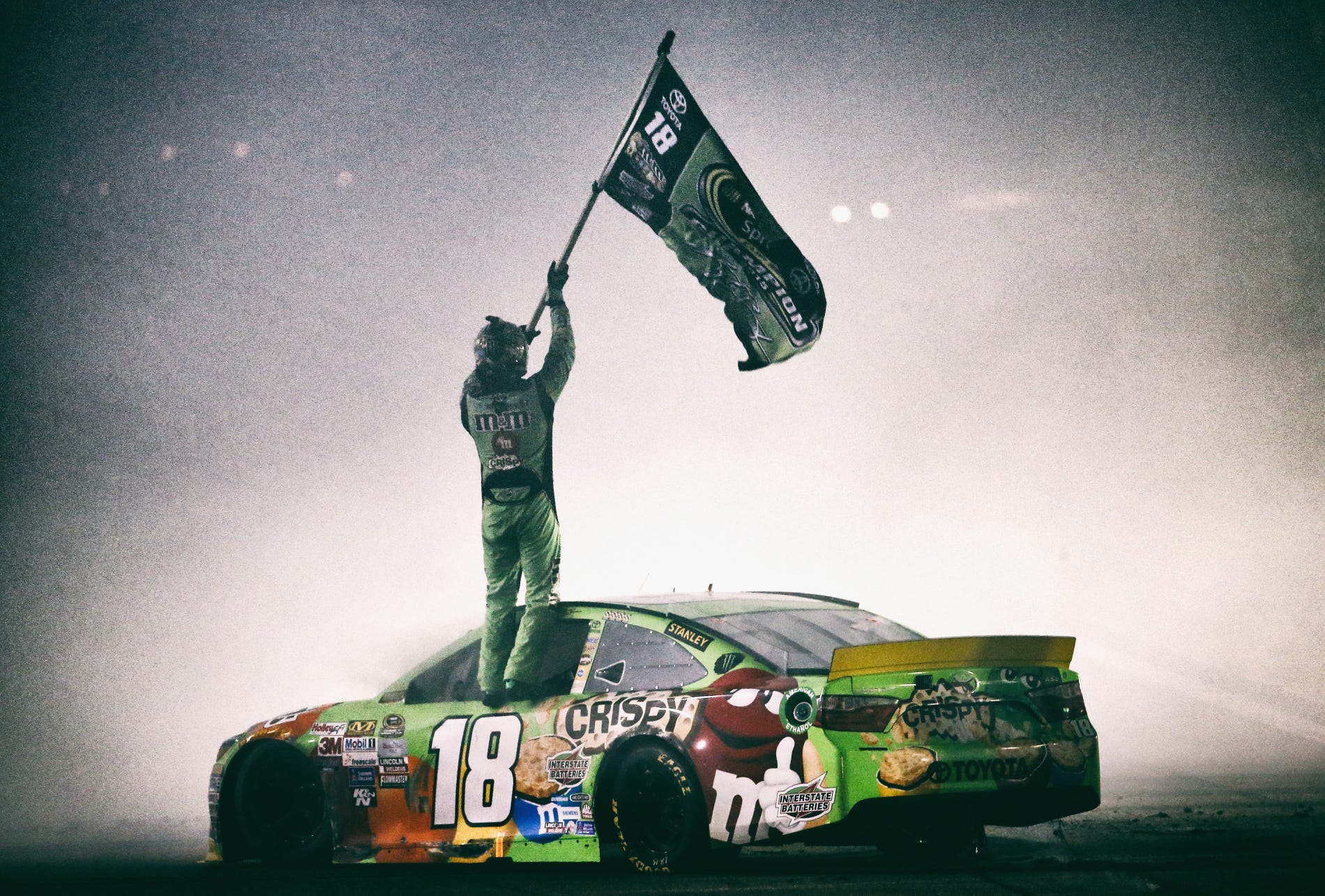
Kyle Busch spent his entire life racing as if every lap was an argument he intended to win. And just a week ago, he was still making those arguments — and still winning them. At Dover last Friday, he added yet another Truck Series victory, No. 69, to his all-time series record. But six days later, and three days before he was scheduled to climb back into a Cup car for the Coca-Cola 600, Busch was suddenly gone.
In news that is still difficult to believe, much less comprehend, the winningest driver in NASCAR history — across the sport’s three national series — and one of its most combative, complicated and brilliant stars, died Thursday at age 41 after being hospitalized with a severe illness.
Busch leaves behind a résumé that is nothing less than titanic in its scale: 234 total national-series wins, two Cup Series championships, 63 Cup victories, 102 O’Reilly Series wins, 69 Truck wins, and more than two decades as a driver who could be hated, feared, resented and admired all at once. He was Rowdy. He was the Candy Man, Wild Thing and KFB. He was also, plainly, one of the greatest racecar drivers who ever lived.
Staring at the chart of all-time cross-series winners, Busch is the most eye-catching and audacious presence of all, sitting at the very top of the list:
Busch literally had more wins than Richard Petty! He had almost double the wins of anyone other than The King. And he did it across more levels than anybody, bar none.
Though it wasn’t named for him — the O’Reilly Series was actually called the Busch Series when he was coming up — many of those wins came through the practice of Buschwhacking, when a Cup driver dips down a level or two to pick up wins. This might be viewed as gratuitous stat-padding, and maybe on a certain level it was, but the practice also existed for drivers to gain more seat time and experience at the week’s track, in the pursuit of excellence on Sunday.
To win 234 total races, including at least 63 in every national series, you had to be obsessed with excellence — and nobody was more obsessed than Busch.
He was the definition of a “racer”, somebody who lived to be behind the wheel of a fast car. It helped that he was very, very good at it. Over the course of his too-short career — he still potentially had a few productive years left — Busch eclipsed a 100.0 Driver Rating, the mark of a truly elite season, nine different times. Since the modern era began in 1972, only two other drivers, Jeff Gordon (11) and Dale Earnhardt Sr. (10), had more — and they might be the two greatest drivers in series history. That’s just how good Busch was.
Of course, getting there was never easy. Busch’s career was a combustible mix of talent, temper and trophies, with almost as many burnt bridges left behind as checkered flags. His acrimonious exit from Hendrick Motorsports in 2007 set a reputation for a driver who refused to be tamed, as did his many high-profile feuds with fellow drivers ranging from Joey Logano to Brad Keselowski and Kevin Harvick (among many others — including John Hunter Nemechek just a few weeks ago). Like any good pro-wrestling character, Busch never shied away from the villain role when it needed to be played.
But the longtime heel had a face turn of sorts in recent years, allowing fans a glimpse at his family life with wife Samantha, son Brexton (born 2015) and daughter Lennix (born 2022). Brexton in particular has become a social-media child star as he follows in his dad’s footsteps to become a pint-sized racer. Watching Busch the father on YouTube, it was easy to forget Busch the on-track antagonist… until he got back behind the wheel again and tangled with your favorite driver.
It’s hard to believe now that, just a few weeks ago, I wrote about the signs that Busch’s 2026 season might turn around — his Richard Childress Racing No. 8 had been improving of late as he sought to end a 105-race winless drought. We’ll never know if and when that streak would have finally ended at the Cup level.
But after winning in the Truck Series at Dover, Busch was asked why those moments never got old. “Because you never know when the last one is going to be,” he said:

He had no way of knowing — none of us did — that it would indeed be his last trip to victory lane. But in a career defined by winning, on his terms, there is something painfully fitting that one of the last memories we’ll have of Kyle Busch as a racer was taking a bow with the checkered flag, the way he’d done hundreds and hundreds of times before.
Filed under: Racing
Not that it particularly matters right now, but I was wondering how you obtained driver ratings for years prior to the advent of loop data in 2005 because I know that a lot of the data used to calculate them (fastest laps, average running position, pass differentials, etc...) are not available for those years (even though a few people in my circles have tried to calculate ARP for previous seasons based on old video footage, which doesn't interest me all that much personally)?
Great lede. Nice piece.