


Today is September 1, which means there’s approximately one month remaining in MLB’s 2026 regular season — and still a lot left to be resolved in what has already been a stubbornly confusing baseball season.
As of Monday afternoon, 16 teams were either in playoff position or sitting within two games of a spot, with 14 teams within a game or less — both the second-most in any season at the end of August since the 1994 strike.
As I’ve noted before, that’s obviously in large part a product of the postseason expanding from eight teams as recently as 2011 to 12 teams now, thrusting a bunch of teams with .500 (or worse) records into the playoff race well past when they should have any shot whatsoever. But that’s also the point: More viable teams — and it being viable at all to chase a playoff spot with a losing record on September 1 — clouds the playoff picture a lot more than ever used to be possible.
(This is how you end up with multiple teams who sold at the trade deadline continuing to win, at least enough to not exit the race completely — despite their front offices having every intention to pack things in for the year.)
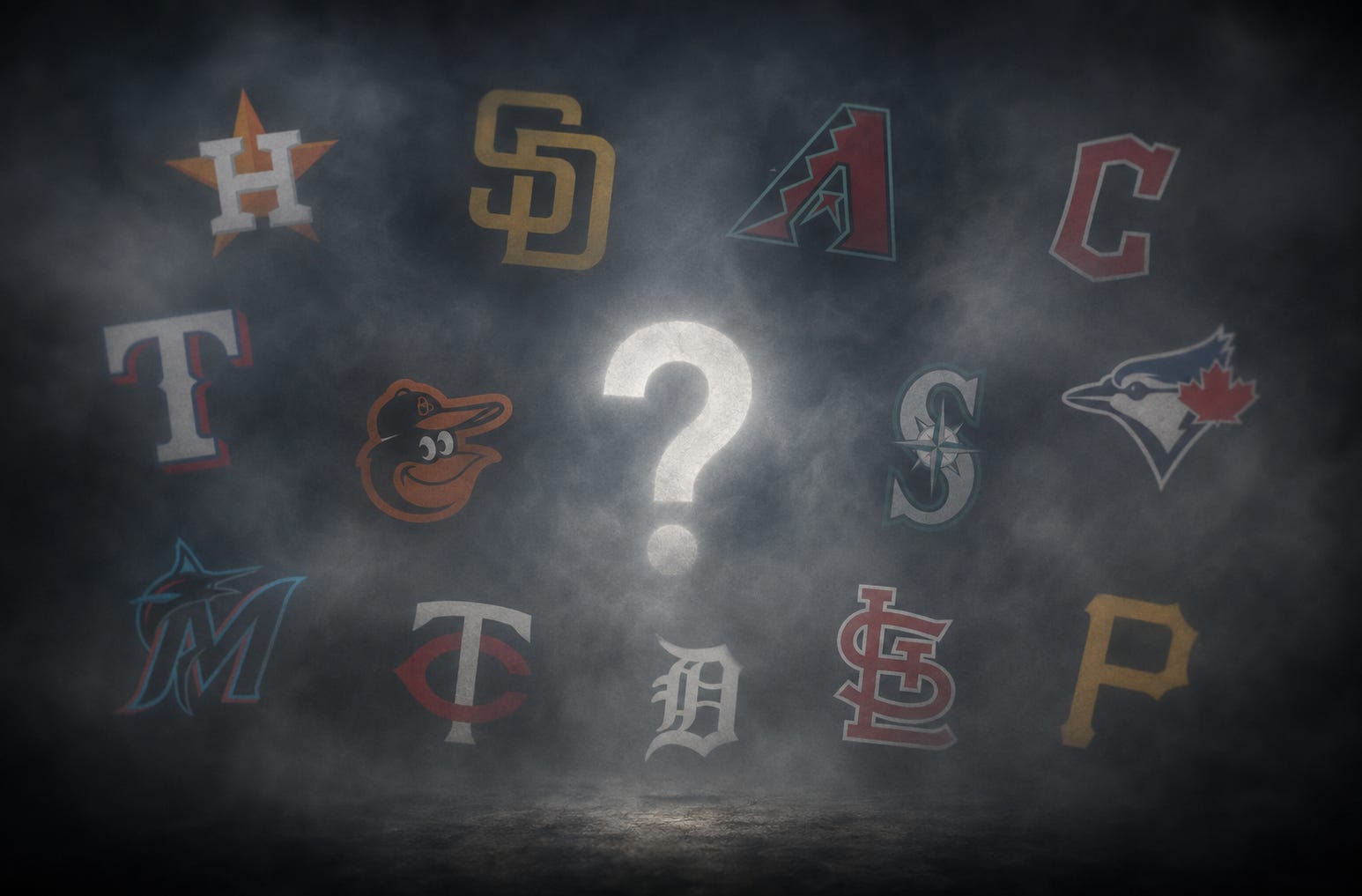
The playoff race has come into at least some increasing focus recently. At noontime on Monday, my MLB Elo forecast odds showed nine teams — the Brewers, Dodgers, Yankees, Rays, Braves, Red Sox, Cubs, Phillies and White Sox — sitting with 90 percent playoff odds or higher. Another 13 teams had dropped below 10 percent — Miami, Minnesota, Detroit, St. Louis, Pittsburgh, Kansas City, the Mets, Washington, Cincinnati, San Francisco, the Angels and Athletics, and Colorado.
That’s 22 total teams with essentially “decided” odds — barring something crazy happening. Back on July 31, only 14 teams were in that category (for good or ill), and on June 30 that tally was only 12. Slowly but surely, the odds are sorting themselves out through the summer months.
Similarly, the average playoff probability for the six most likely playoff teams in each league has grown steadily. In the AL, the Top-6 average climbed from 75.0 percent at the end of June and 75.8 percent after July, to 84.2 percent as of Monday afternoon. And over in the NL, the Top-6 average went from 80.4 percent after June to 83.8 percent at the end of July, and an overwhelming 90.9 percent on Monday.
But even with that growing certainty — driven in part by division leaders solidifying their own chances — there still remain eight teams wedged between 10 percent and, not just 90 percent, but 70 percent odds.
Two of those teams are NL squads basically going after one open wild-card spot: the San Diego Padres and Arizona Diamondbacks. On Monday, the race was practically a coin-flip in Elo (52-48 S.D. leading), and little else offers much in the way of daylight between these two teams.
The D-Backs went into Monday up just a half-game. San Diego is 15th in the BaseRuns rankings; Arizona 16th. Arizona is 15th in WAR; San Diego 17th. San Diego barely has the better RPG differential, +0.07 to +0.04. The D-Backs played the easier schedule beforehand (12th-hardest versus 9th for S.D.); the Padres play the easier slate going forward (21st-hardest versus 15th for Arizona).
Who has the edge? It might be whoever can get to 87 wins by the last day of the regular season. In the Elo simulations, the average third wild-card team from the NL had 86.64 wins — including 86.65 wins when the Padres win it and 86.56 when the Diamondbacks win it. The median for each bucket? 87 wins.
As for the AL, things are a lot more complicated. For one thing, no division is terribly certain with a month left; the White Sox, at 84 percent in the Central, went into Monday as the heaviest favorite.1 So that alone scrambles the odds around who will ultimately be in the wild-card mix. And then, there’s the matter of the weak AL West, whose winner will obviously make the playoffs, but whose runner-up is unlikely to.
That leaves us with six teams jammed between 10 percent and 70 percent odds, fighting over just two spots: the Houston Astros, Cleveland Guardians, Texas Rangers, Toronto Blue Jays, Baltimore Orioles and Seattle Mariners.
Of those, we can basically set the AL West (Houston, Texas, Seattle) teams off to the side on their own, pursuing one spot — because none are likely to grab a wild-card otherwise. Houston went into Monday with a multi-game division lead and nearly 70 percent odds, with Texas and Seattle becoming increasingly remote challengers.
At the same time, the Guardians, Blue Jays and Orioles are almost purely fighting for the AL’s last wild-card spot. Cleveland still has some chance to erase the White Sox’s lead in the Central, but it’s far more likely that their playoff berth — if it happens — would come via the wild card. Between that CLE/TOR/BAL trio, the Guardians have the best BaseRuns expected win percentage, the most WAR and the best RPG differential — they’re also the only one who purely was a buyer at the deadline — and they only face the 20th-toughest remaining schedule, so they ought to be able to get the job done.
(Even if it bears mentioning that Seattle faces by far MLB’s easiest remaining schedule from here.)
But we just don’t know yet, which is the joy of pennant-race baseball. And that uncertainty feels a little more precious than usual this year, given the looming labor crisis hanging over the sport’s future this coming winter (and beyond).

As of Monday, prediction-market traders only gave 9 percent odds that MLB’s owners and players would agree to a new Collective Bargaining Agreement before December 2, the day after the current CBA expires. That’s not to say a new deal can’t be achieved by Spring Training 2027, but it’s also far from guaranteed that baseball’s cherished fall-to-winter-to-spring cycle will proceed uninterrupted.
And as Ben from Forever the Show wrote recently, this “lockout derangement syndrome” is contributing to a general feeling that we’re all “pre-missing” baseball before it’s even gone. That’s a feeling I always get a little by season’s end anyway, as baseball has the ability to mark the passing of time and calendar seasons — and one’s own life — more than other sports. But it’s amplified now that every successive day of the season means the beauty and uncertainty of playoff races, award chases and all the little unresolved possibilities of September baseball move from the future into the past, with the chance that no new future fills them back in on the other side.
So maybe there’s something to be said for appreciating the confusion of the current playoff race while we still have it. The 2026 season has spent months steadfastly refusing to decide which teams belong in October, and how this whole logjam in the standings is supposed to conclude. Now, with just a month left to finally give us some answers, I wish the baseball gods would just slow down and take their time.
Filed under: Baseball
For comparison’s sake, every NL division favorite was at 89 percent or higher.